
There are very few artists in the history of the comic medium whose work is recognizable to just about everyone. You don't have to be a comic collector, an art enthusiast, or even a regular reader of the funny pages to recognize the round head of Charlie Brown or the silhouette of Snoopy lying on top of his doghouse. That is the incredible legacy of Charles M. Schulz.
Born on this day over a century ago. November 26, 1922, in Minneapolis, Minnesota, Schulz would go on to become one of the most important cartoonists of the 20th century.
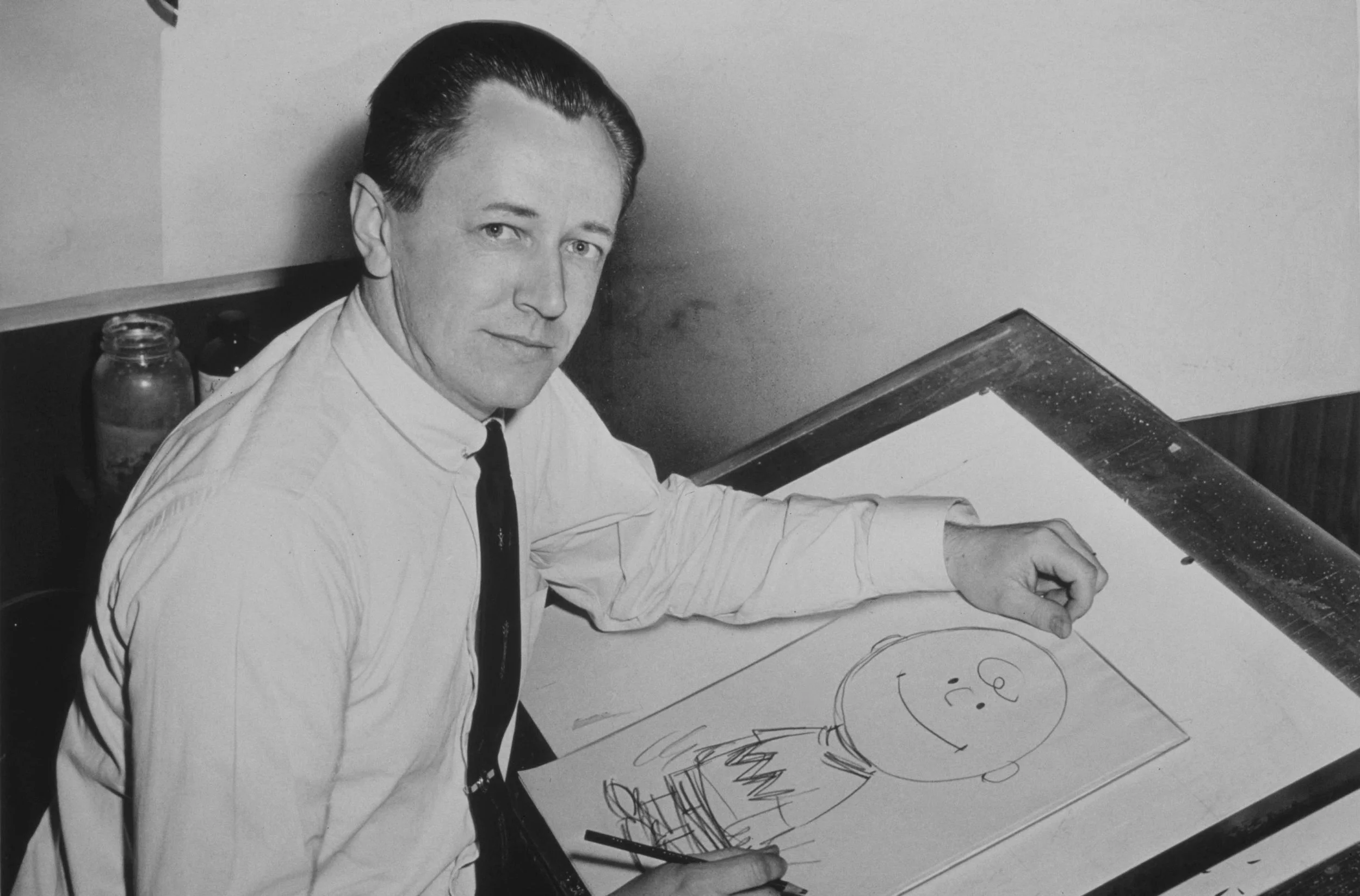
The Man They Called Sparky
Almost destined to become a cartoonist, Schulz was given the nickname “Sparky” shortly after his birth, named after the horse Spark Plug from Billy DeBeck's popular comic strip Barney Google.
Schulz grew up reading the Sunday funnies with his father, developing an appreciation for the works of cartoonists who came before him. One of his earliest published pieces of artwork appeared in Ripley's Believe It or Not! in 1937. It was a drawing of his childhood dog, Spike, who would eventually serve as the inspiration for one of the most famous dogs in popular culture.
Like many of the great comic artists of his generation, Schulz served in World War II before returning home to pursue a career in the arts. In 1947, he began producing a newspaper feature titled Li'l Folks. Looking back at those early cartoons, you can already see the beginnings of what would become Peanuts.
The Birth of an American Icon
On October 2, 1950, Peanuts made its debut in just seven newspapers across the United States. Interestingly enough, Schulz never cared for the title, which was chosen by his syndicate.
What started as a relatively simple comic strip about a group of neighborhood children would become one of the biggest cultural phenomenons in American history.
What made Peanuts so special was that Schulz understood the human condition. Charlie Brown was a character that just about anyone could relate to. He was insecure, constantly disappointed and desperate to succeed at something, yet no matter how many times life knocked him down, he kept coming back for more.
Lucy was wonderfully obnoxious, Linus was philosophical beyond his years, Schroeder was consumed by his love of Beethoven, and Snoopy lived in a world that was entirely his own.
These were children dealing with some surprisingly adult emotions. Loneliness, rejection, friendship, faith, failure and the pursuit of happiness were all explored within the confines of a newspaper comic strip.
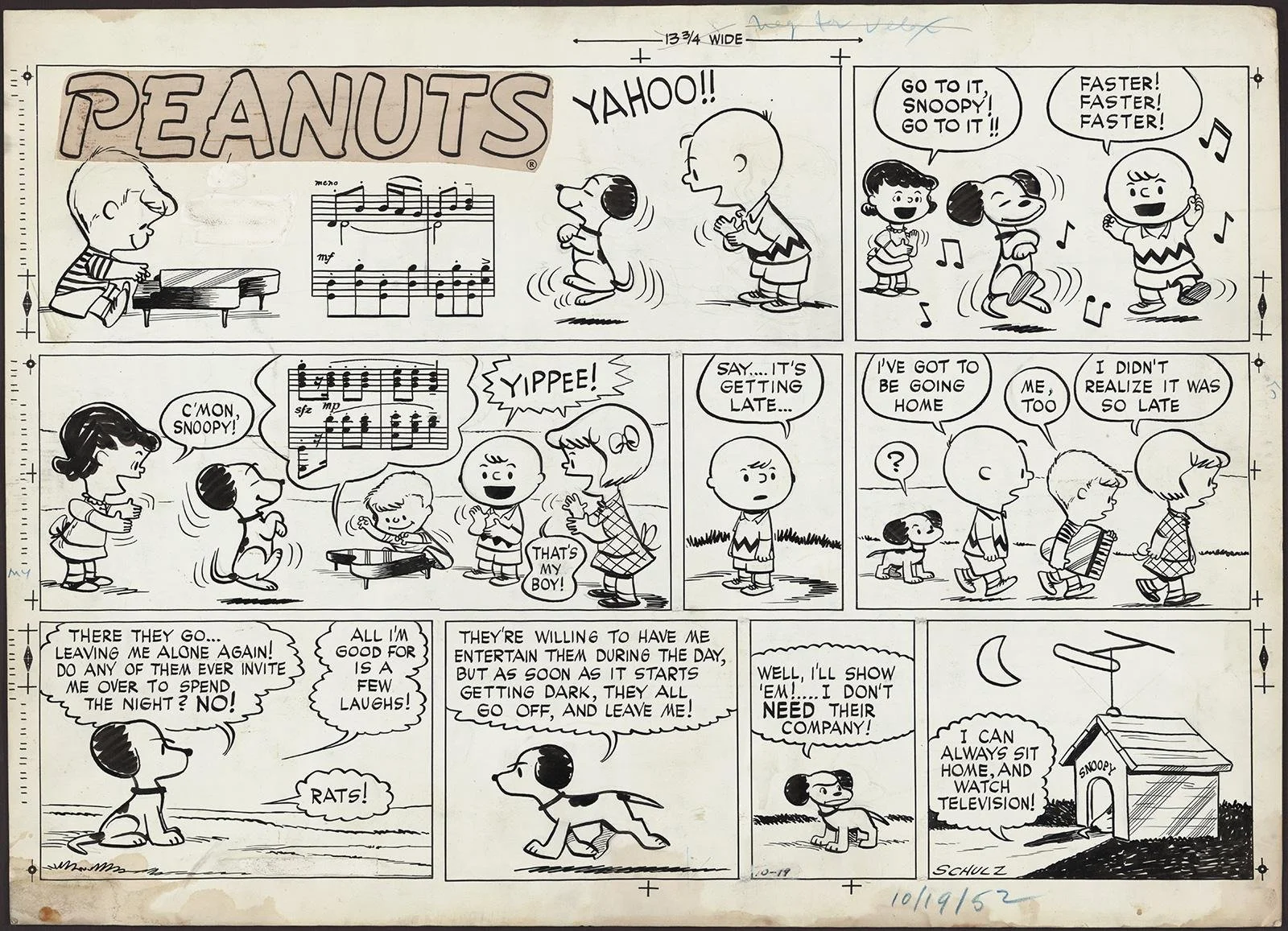
The Genius of Simplicity
Here at Robo Picto, we spend a great deal of time appreciating the incredible detail of artists like Frank Frazetta, Jack Kirby, Alex Schomburg and Berni Wrightson. Schulz represents an entirely different kind of artistic brilliance.
Take a moment to really look at a Schulz original. There is rarely an unnecessary line on the page. A slight change in the position of an eyebrow, the curve of a mouth or the posture of Charlie Brown could completely change the emotion of a panel.
Schulz understood pacing, composition, expression and the importance of silence. Sometimes the funniest or most powerful panel in a Peanuts strip contained no dialogue whatsoever.
There is something remarkable about an artist who could accomplish with a handful of pen strokes what others might need an entire page to convey.
From the Funny Pages to the Comic Books
While most people associate Peanuts with newspaper strips, there is also a fascinating history for comic book collectors to explore.
Beginning in 1952, Peanuts found its way into traditional comic books. Publishers including United Feature, St. John and eventually Dell brought Charlie Brown and the gang to the newsstands alongside the superheroes, monsters, cowboys and crime comics of the era.
The Dell comics are particularly interesting because they featured original material in addition to newspaper reprints, with artists such as Jim Sasseville and Dale Hale contributing to the books.
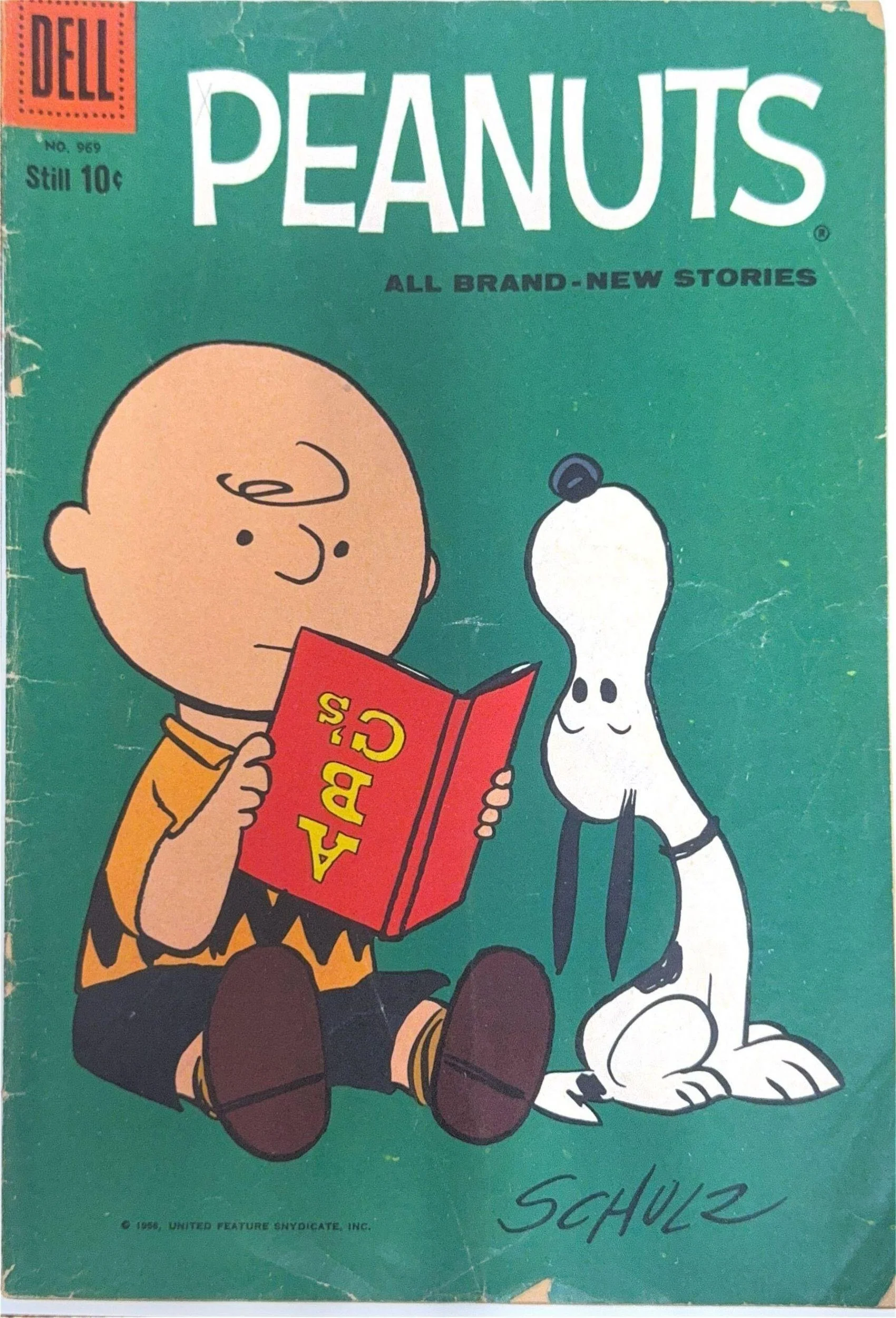
For collectors of vintage Americana, these early Peanuts comics are a wonderful little corner of the hobby that deserves more appreciation.
Beyond the Comic Strip
It would be nearly impossible to discuss the legacy of Charles Schulz without mentioning the animated holiday specials.
A Charlie Brown Christmas (1965), It's the Great Pumpkin, Charlie Brown (1966) and A Charlie Brown Thanksgiving (1973) have become annual traditions for generations of families.
The combination of Schulz's characters and the unmistakable music of Vince Guaraldi created something truly timeless. There is a certain charm to those early animated specials that has never quite been replicated.
By 1969, Charlie Brown and Snoopy had even made their way into the Apollo space program, lending their names to the command and lunar modules of Apollo 10.
Not bad for a little comic strip that started in seven newspapers!
An Artist Until the Very End
Perhaps the most impressive accomplishment of Schulz's career was his dedication to his work.
Over the course of nearly 50 years, Schulz produced an astonishing 17,897 Peanuts comic strips. He personally wrote, drew, inked and lettered them.
Think about that for a moment. Nearly half a century of sitting down at a drawing board and finding something new to say with the same group of characters.
Schulz passed away on February 12, 2000, at the age of 77. His final original Peanuts strip appeared in newspapers the following morning.
There is something incredibly poetic and heartbreaking about that. An artist who had dedicated his entire life to his craft said goodbye to his readers just as the world was saying goodbye to him.
The Legacy of Charles Schulz
When discussing the greatest artists in the history of comics, Charles Schulz absolutely deserves a seat at the table.
He didn't need superheroes, elaborate splash pages or fantastical worlds to captivate millions of readers. All he needed was a neighborhood, a handful of children, a rather imaginative beagle and a pen.
More than 75 years after the debut of Peanuts, his characters remain as relevant as ever. We still root for Charlie Brown to kick that football. We still hope Linus will finally see the Great Pumpkin. And we still find a little bit of ourselves in those wonderfully imperfect characters.
That is the genius of Charles Schulz.
Happy Birthday, Sparky!
LONG LIVE THE COLLECTOR!
